
Every product a business manufactures, every litre of water a factory consumes, every tonne of carbon emitted by industrial activity interacts with ecosystems – the complex, interlocking networks of living organisms and physical environments that sustain life on Earth. Ecosystems provide the biological foundation for agriculture, water supply, climate stability, and the raw material supply chains that power the Indian economy. When ecosystem functions degrade, the consequences reach far beyond wildlife – they surface as water scarcity in Chennai’s industrial estates, reduced crop yields in Tamil Nadu’s Cauvery delta, and supply chain disruptions for FMCG companies dependent on agricultural inputs.
The function of ecosystem is now a subject of corporate governance, not merely ecology. The Taskforce on Nature-related Financial Disclosures (TNFD) – launched in 2023 with participation from over 40 global financial institutions – provides a framework for companies to assess and disclose nature-related risk and opportunity, modelled on the Task Force on Climate-related Financial Disclosures (TCFD). The Securities and Exchange Board of India (SEBI) Business Responsibility and Sustainability Reporting (BRSR) framework includes biodiversity disclosure under Principle 6 (Environment). The Global Reporting Initiative (GRI) Standard 304 (Biodiversity) requires companies to assess the impact of their operations on protected areas and habitats that host critical ecosystem functions.
For Indian manufacturing companies, mining operators, chemical manufacturers, and FMCG brands – particularly those operating near ecologically sensitive zones in Tamil Nadu, the Western Ghats, the Gangetic plains, and coastal areas – understanding the function of ecosystems is the starting point for quantifying biodiversity risk, managing environmental compliance obligations, and building the ESG Environmental pillar disclosures that investors and regulators increasingly scrutinise.
What Is an Ecosystem?
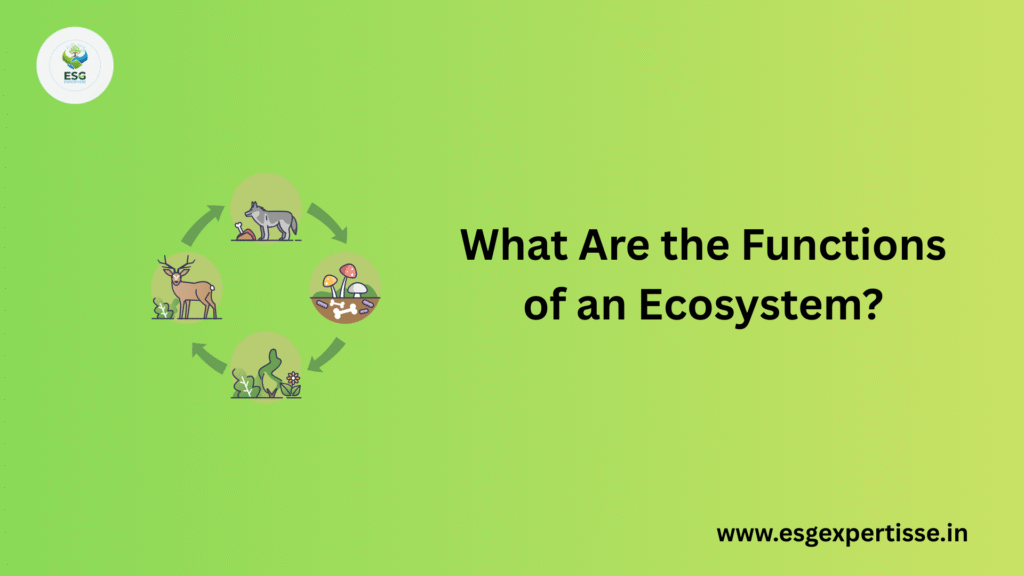
An ecosystem is a functional unit of nature consisting of all living organisms (the biotic component – plants, animals, bacteria, fungi) in a given area interacting with the non-living physical environment (the abiotic component – sunlight, water, soil, temperature, and atmospheric gases) as an integrated system. Ecosystems exchange energy and matter continuously – making them dynamic, self-regulating systems rather than static collections of species.
Ecosystems exist at every scale and in every environment. Natural ecosystems include tropical rainforests (Western Ghats, Northeast India), mangrove systems (Tamil Nadu’s Pichavaram and Muthupet), freshwater rivers and wetlands (Cauvery, Chilika Lake), marine systems (Gulf of Mannar coral reefs), grasslands, and deserts. Artificial or managed ecosystems include agricultural land (India’s 140 million hectares of cultivated area), plantation forests, aquaculture ponds, and urban green spaces. Both natural and artificial ecosystems perform the same core ecological functions – but degraded or simplified ecosystems perform them less efficiently and with lower resilience.
For businesses, the ecosystem type most relevant to operations depends on geography and sector: a Tamil Nadu textile manufacturer near the Noyyal River interacts with a freshwater river ecosystem; a cement company quarrying in a hill district interacts with a forest ecosystem; an FMCG company sourcing palm oil interacts with tropical plantation and forest ecosystem interfaces. Identifying ecosystem type is the first step in TNFD-aligned nature-related risk assessment – a disclosure framework that leading Indian companies are beginning to implement alongside BRSR environmental reporting.
Core Functions of an Ecosystem
1. Energy Flow
Energy flow is the unidirectional transfer of energy through an ecosystem from solar input through successive trophic levels – producers, primary consumers, secondary consumers, tertiary consumers, and decomposers. Solar energy enters the ecosystem through photosynthesis – green plants (producers) convert approximately 1–2% of incident solar radiation into chemical energy stored in organic molecules. This energy transfers through the food chain as organisms consume each other.
The 10% energy transfer rule – formalised by Raymond Lindeman (1942) – states that only approximately 10% of the energy stored at one trophic level transfers to the next. A grassland ecosystem receiving 10,000 kcal of solar energy converts approximately 100–200 kcal into plant biomass (gross primary productivity); herbivores capture approximately 10–20 kcal; carnivores capture approximately 1–2 kcal. This progressive energy dissipation limits food chain length and determines ecosystem carrying capacity.
Food chains represent linear energy transfer sequences (grass → grasshopper → frog → snake → eagle). Food webs represent the realistic, interconnected energy transfer networks in which each organism participates in multiple food chain relationships. In Tamil Nadu’s Pichavaram mangrove ecosystem – one of the world’s largest mangrove forests at approximately 1,100 hectares – mangrove detritus (decomposing leaves and roots) forms the base of a detritus-based food web that supports fish, crabs, and migratory birds, ultimately sustaining the coastal fishery on which approximately 6,000 fishing families depend.
For businesses, energy flow disruption translates directly to commercial risk: deforestation that eliminates pollinator populations disrupts the energy flow supporting agricultural production; industrial effluent that kills primary producers in a river ecosystem collapses the food web supporting fish populations that fishing communities depend on – generating livelihood disruption, regulatory enforcement, and reputational risk for the discharging company.
2. Nutrient Cycling
Nutrient cycling – also called biogeochemical cycling – is the movement of chemical elements essential for life (carbon, nitrogen, phosphorus, sulphur, water) through biological, geological, and atmospheric pathways. Unlike energy (which flows unidirectionally through ecosystems and dissipates as heat), nutrients cycle continuously – moving between living organisms, soil, water, and atmosphere in closed or semi-closed loops.
The carbon cycle moves CO₂ from the atmosphere into plant biomass through photosynthesis, transfers carbon to consumers through food chains, returns carbon to the atmosphere through respiration and decomposition, and sequesters long-term carbon in soil organic matter, ocean sediments, and fossil deposits. Terrestrial ecosystems – forests, grasslands, and wetlands – store approximately 45% of terrestrial carbon in living biomass and soil organic matter. When forests are cleared or wetlands drained, stored carbon releases to the atmosphere as CO₂ – contributing to global warming and reducing the carbon sequestration capacity that acts as a buffer against climate change.
The nitrogen cycle transforms atmospheric nitrogen (N₂, inert and unusable by most organisms) into biologically available forms through nitrogen fixation (by bacteria such as Rhizobium in legume root nodules), nitrification, and denitrification. Agricultural soils in Tamil Nadu’s Cauvery delta – intensively cultivated for rice, sugarcane, and bananas – depend on functional nitrogen cycling for crop nutrition. Industrial nitrogen fertiliser application at rates exceeding soil cycling capacity generates nitrous oxide (a potent greenhouse gas with approximately 273 times the 100-year warming potential of CO₂) and nitrogen runoff that eutrophies adjacent water bodies – disrupting aquatic ecosystem function and generating GRI 304 biodiversity disclosure obligations for FMCG companies sourcing crops from these agricultural zones.
3. Primary Productivity
Primary productivity is the rate at which photosynthetic organisms – plants, algae, and cyanobacteria – convert solar energy into organic biomass. Gross Primary Productivity (GPP) is the total rate of photosynthesis, including the energy producers consume in their own respiration. Net Primary Productivity (NPP) is GPP minus the plant’s own respiration cost – representing the biomass available for consumption by higher trophic levels and decomposers.
Forest ecosystems demonstrate the scale of primary productivity in India’s ecological context. India’s forests cover approximately 21.7% of the national territory (Forest Survey of India, 2023) and sequester approximately 424 million tonnes of CO₂-equivalent annually in growing biomass and soil carbon. This sequestration constitutes a natural carbon sink that offsets a portion of India’s industrial GHG emissions – making forest ecosystem productivity a direct climate mitigation asset. The economic value of this sequestration, calculated under voluntary carbon market frameworks, runs into thousands of crores of rupees annually.
Agricultural primary productivity is the basis of India’s food security. India’s agricultural sector supports approximately 600 million livelihoods – its productivity depends on soil health, water availability, and pollination services all delivered by functioning ecosystems. Reduced primary productivity in agricultural ecosystems – from soil degradation, water table depletion, pollinator decline, or climate-driven precipitation shifts – generates food price volatility, rural income disruption, and raw material supply chain risk for FMCG, dairy, and textile companies sourcing agricultural commodities.
4. Decomposition
Decomposition is the biological breakdown of organic matter – dead plant material, animal carcasses, excreta, and metabolic waste – into inorganic nutrient forms by bacteria, fungi, and invertebrates. Decomposition is the closing mechanism of nutrient cycling: organic carbon and nutrients locked in dead biomass become available again for plant uptake through the decomposer-mediated mineralisation process.
The rate of decomposition determines the fertility of soil – the most critical natural capital asset for agricultural businesses. Tropical ecosystems with high temperature and humidity – like the Western Ghats and Tamil Nadu’s wet zones – support rapid decomposition rates that maintain high soil organic matter turnover. Industrial practices that disrupt decomposer communities – soil compaction from heavy machinery, chemical pesticide overuse, waterlogging from irrigation mismanagement – slow decomposition rates, reduce soil fertility, and ultimately require compensatory fertiliser inputs that generate Scope 1 and Scope 3 greenhouse gas emissions.
The microbiome of healthy agricultural soil contains approximately 100 million to 1 billion bacteria per gram – performing decomposition, nitrogen fixation, and phosphorus solubilisation functions simultaneously. Industrial soil degradation that kills soil microbial communities destroys this biological infrastructure, imposing remediation costs and yield losses that directly affect FMCG and agribusiness supply chains. GRI Standard 304 Biodiversity requires companies to assess the impact of their operations on ecosystems – including soil ecosystem functions that support adjacent agricultural systems.
Ecosystem Services vs Ecosystem Functions
Ecosystem functions and ecosystem services are related but distinct concepts that frequently appear together in ESG environmental reporting frameworks. Conflating them generates imprecise biodiversity risk assessments – the distinction is operationally significant for TNFD and GRI 304 disclosure accuracy.
Ecosystem functions are the natural biological, chemical, and physical processes that operate within an ecosystem – energy flow, nutrient cycling, decomposition, productivity. These processes occur whether or not humans benefit from them; they describe what the ecosystem does internally. Ecosystem services are the specific benefits that human populations derive from ecosystem functions – food supply from agricultural productivity, flood regulation from mangrove water buffering, climate stabilisation from forest carbon sequestration, cultural value from biodiversity. Ecosystem services describe the outputs of ecosystem functions that have measurable value to human welfare.
| Dimension | Ecosystem Functions | Ecosystem Services |
| Nature | Natural ecological processes | Benefits derived by humans from ecosystem processes |
| Examples | Energy flow; nutrient cycling; decomposition; productivity | Food supply; clean water; flood control; carbon sequestration |
| Measurement | Biological and chemical rates (GPP, NPP, decomposition rate) | Economic or social value (Rs. per hectare, lives protected) |
| Business Relevance | Foundation – determines whether services are possible | Operational dependency – what business activities require |
| ESG Framework | TNFD nature risk assessment; GRI 304 biodiversity | BRSR Principle 6 environmental impact; TNFD opportunity |
| Degradation Risk | Industrial activity disrupts underlying processes | Business loses access to water, food inputs, carbon offsets |
Why Ecosystem Functions Matter for ESG
The Environmental pillar of the Environmental, Social and Governance (ESG) framework is not limited to carbon emissions and energy consumption. ESG environmental risk encompasses biodiversity loss, water dependency, ecosystem degradation, and the regulatory and reputational consequences of business activities that disrupt natural processes. For Indian businesses operating in or near ecologically sensitive areas, ecosystem function degradation generates material financial risk – rated by the World Economic Forum’s Global Risks Report 2024 as the second-highest long-term global risk by impact.
• Biodiversity risk: The Intergovernmental Science-Policy Platform on Biodiversity and Ecosystem Services (IPBES) estimates that approximately 1 million species face extinction risk – primarily from habitat conversion, pollution, overexploitation, invasive species, and climate change. Indian businesses that source commodities from biodiversity-critical landscapes (Western Ghats, Sundarbans, Indo-Gangetic plains) carry biodiversity-related supply chain risk. GRI Standard 304 (Biodiversity) requires companies to identify operations in or adjacent to protected areas and biodiversity hotspots – a disclosure obligation that BRSR Principle 6 incorporates.
• Water dependency: Freshwater ecosystem functions – including hydrological regulation, water purification, and groundwater recharge – support industrial water supply, agricultural irrigation, and municipal drinking water. Tamil Nadu’s industrial clusters in Tiruppur, Coimbatore, and Chennai draw heavily on groundwater and surface water systems whose recharge depends on intact watershed ecosystem functions. The Central Ground Water Board identifies severe over-exploitation of groundwater in Tamil Nadu’s industrial districts – a direct consequence of ecosystem function disruption at watershed scale.
• Supply chain vulnerability: Agricultural commodity supply chains – cotton, sugarcane, rice, oilseeds – depend on pollination services (declining with bee population loss), soil fertility (declining with microbial community disruption), and water regulation (declining with wetland conversion). FMCG companies, textile manufacturers, and food processors that source these commodities from degraded agricultural ecosystems face input quality variability, yield decline, and price volatility – all measurable supply chain financial risks.
• Carbon regulation: Forests and wetlands that sequester carbon perform a climate regulation ecosystem function that directly offsets industrial GHG emissions. India’s National Forest Policy targets 33% forest cover, and carbon sequestration from forest ecosystems forms part of India’s NDC commitment. Companies that destroy forest ecosystem carbon sinks – through land conversion or supply chain commodity sourcing linked to deforestation – generate Scope 3 land use change emissions that increasingly attract scrutiny from investors applying TNFD and GRI 304 standards.
• Climate resilience: Coastal ecosystems – mangroves, coral reefs, seagrass beds – provide storm surge protection, coastal erosion control, and fishery support that protect coastal industrial infrastructure. Tamil Nadu’s 1,076-kilometre coastline hosts significant industrial assets in Chennai, Ennore, Cuddalore, and Tuticorin. Mangrove degradation – from aquaculture expansion and industrial encroachment – reduces the coastal buffering function that protects these assets against cyclone impacts intensified by climate change.
The TNFD (Taskforce on Nature-related Financial Disclosures) framework – released in September 2023 – provides Indian companies with a structured four-step process (LEAP: Locate, Evaluate, Assess, Prepare) for assessing nature-related risk and opportunity. TNFD aligns with SEBI BRSR Principle 6 environmental disclosure requirements and with GRI 304 biodiversity reporting standards, creating a coherent framework for ecosystem function risk disclosure in Indian corporate reporting. The biodiversity in ESG reporting resource from ESG Expertisse provides guidance on implementing TNFD-aligned assessments.
Impact of Industrial Activities on Ecosystem Functions
Industrial activities disrupt ecosystem functions through four primary pathways – physical habitat modification, chemical pollution, water extraction, and carbon emission. Each pathway generates specific ecosystem function impairments that cascade into business risk for the disrupting company and for supply chain-dependent businesses in the same region.
• Mining – nutrient disruption and habitat removal: Open-cast mining operations physically remove topsoil, subsoil, and rock overburden – destroying the soil microbial communities that perform decomposition and nutrient cycling functions. Limestone quarrying in Tamil Nadu’s Ariyalur and Salem districts removes forest and agricultural ecosystem substrate, generating soil nutrient depletion in adjacent areas, sediment discharge into rivers, and loss of primary productivity on reclaimed mine sites that takes decades to restore. Mining companies operating under GRI 304 reporting obligations must assess impacts on adjacent ecosystem functions – not merely on species within the mine boundary.
• Manufacturing – air and water pollution affecting productivity: Industrial air pollution – particulate matter, sulphur dioxide, nitrogen oxides – reduces photosynthetic efficiency of vegetation within the pollution plume, reducing primary productivity and carbon sequestration function in surrounding ecosystems. Industrial effluent discharge – from textile dyeing, tanneries, chemical plants – introduces nitrogen, phosphorus, heavy metals, and synthetic compounds that disrupt aquatic nutrient cycling, kill decomposer communities, and generate algal blooms that deplete dissolved oxygen and collapse freshwater food webs. The dyeing effluent issue in Tamil Nadu’s Noyyal River system – driven by Tiruppur’s textile cluster – represents a documented case of industrial activity disrupting multiple ecosystem functions simultaneously across hundreds of kilometres of river ecosystem.
• Water extraction – hydrological imbalance: Industrial and agricultural groundwater extraction at rates exceeding aquifer recharge disrupts the hydrological cycle – a core ecosystem function that regulates water availability, flood buffering, and groundwater-dependent ecosystem health. Tamil Nadu’s manufacturing clusters in Coimbatore, Tiruppur, and Chennai draw significantly on deep aquifers with recharge times measured in decades. Groundwater depletion reduces wetland water tables, dries seasonal streams, and ultimately reduces the water purification and hydrological regulation functions that communities and industries downstream depend on.
How Businesses Can Protect Ecosystem Functions
Protecting ecosystem functions requires businesses to move beyond pollution compliance – treating ecosystem health as an operational risk management priority and an ESG Environmental pillar performance dimension. ESG Expertisse recommends the following framework for Indian businesses building ecosystem function protection into their ESG strategies:
✓ Conduct biodiversity and ecosystem risk mapping – Use TNFD’s LEAP framework (Locate, Evaluate, Assess, Prepare) to identify which ecosystems the company’s operations and supply chains depend on or impact. Map operations against India’s ecologically sensitive zones: Western Ghats Eco-Sensitive Areas, coastal regulation zones, wildlife corridors, and Protected Area buffers. Document dependencies on ecosystem services – water from watershed forests, pollination from adjacent natural habitats, flood protection from coastal mangroves.
✓ Monitor and reduce water usage – Measure absolute water withdrawal, water consumption, and wastewater discharge by facility and water source type (groundwater, surface water, municipal supply). Set water reduction targets for high-water-risk facilities – particularly those operating in Tamil Nadu’s over-exploited groundwater districts. Implement closed-loop water recycling for industrial processes – textile dyeing and automotive component washing generate high-volume wastewater amenable to treatment and reuse.
✓ Reduce emissions affecting ecosystem air quality – Prioritise reduction of industrial air pollutants – SO₂, NO₂, particulate matter – beyond statutory compliance thresholds. Install continuous emissions monitoring systems (CEMS) required by Tamil Nadu Pollution Control Board for large industries. Reducing air pollution co-reduces GHG emissions and protects photosynthesis-dependent ecosystem productivity in surrounding landscapes.
✓ Implement supplier environmental screening – Extend ecosystem function risk assessment into supply chains. Screen agricultural commodity suppliers for deforestation risk, soil health practices, and water management. FMCG and textile companies sourcing from India’s agricultural belts carry Scope 3 biodiversity risk that GRI 304 and TNFD require assessment. Supplier environmental scorecards – including ecosystem impact criteria – reduce supply chain biodiversity risk and improve BRSR Principle 6 disclosure quality.
✓ Align ESG reporting with GRI 304, TNFD, and BRSR – Disclose biodiversity risk and ecosystem impact in annual ESG and BRSR reports. GRI Standard 304 (Biodiversity) requires disclosure of: operations in/near protected areas, significant biodiversity impacts, habitats protected or restored. TNFD’s LEAP framework generates the nature-related risk and opportunity data for TNFD-aligned disclosure. SEBI BRSR Principle 6 environmental disclosures require biodiversity impact assessment – companies that build this capacity now satisfy current obligations and prepare for progressively tightening regulatory expectations.
Frequently Asked Questions
What are the four main functions of an ecosystem?
The four main ecosystem functions are energy flow, nutrient cycling, primary productivity, and decomposition. These processes regulate how energy enters ecosystems, how nutrients are reused, how biomass is produced, and how organic matter is broken down to sustain life.
What is energy flow in an ecosystem?
Energy flow is the one-way movement of solar energy through trophic levels—from producers to consumers and decomposers. Only about 10% of energy is transferred between levels, limiting food chain length and ecosystem capacity.
What is nutrient cycling?
Nutrient cycling is the continuous movement of essential elements like carbon, nitrogen, and phosphorus through living organisms, soil, water, and the atmosphere. Unlike energy, nutrients are reused within the ecosystem.
What is the difference between ecosystem function and ecosystem services?
Ecosystem functions are natural processes such as nutrient cycling and energy flow, while ecosystem services are the benefits humans derive from these processes, like food production, water purification, and climate regulation.
Why are ecosystem functions important for biodiversity?
Ecosystem functions maintain soil fertility, energy availability, and habitat stability—conditions necessary for species survival. Disruptions to these functions directly lead to biodiversity loss.
How do industries affect ecosystem functions?
Industries impact ecosystem functions through habitat destruction, pollution, excessive resource extraction, and greenhouse gas emissions, which disrupt natural processes and reduce ecosystem stability.